
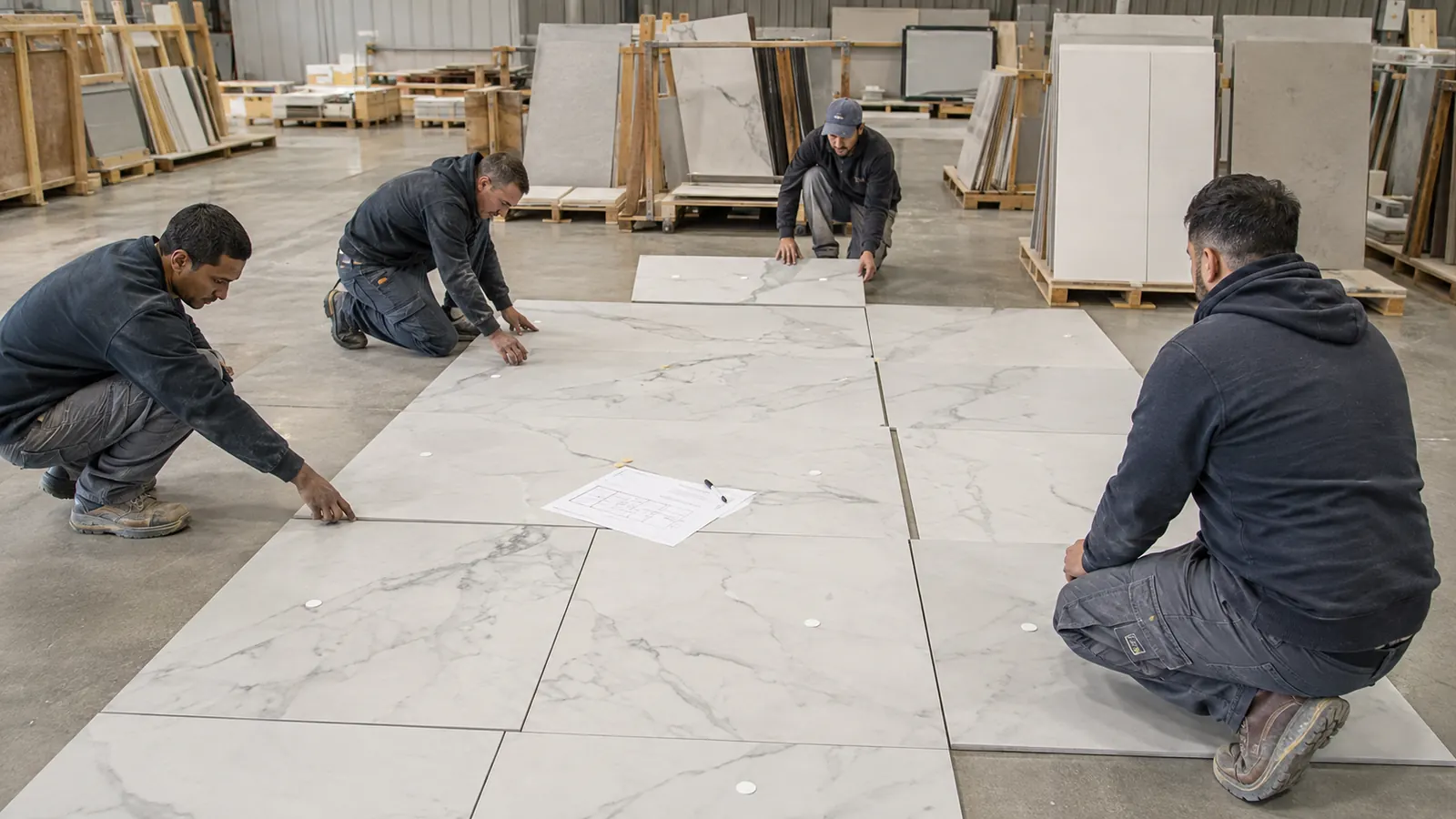
A tile dry lay approval record should be a photographed and numbered layout record tying the represented tile batch, orientation, shade range, pattern sequence, joint assumption, key cuts and authorized comments to a defined room or panel scope. Its release question is whether the represented visual arrangement and cut logic are approved for the stated batch and location without treating a dry lay as proof of installed performance. Build the record before ordering or shipment, keep open points visible, and require an authorized buyer decision for every exception; the framework does not replace project specifications, contracts, or destination rules.
Author: Andy, Director of Operations
Technical reviewer: Andy, Director of Operations
Last substantive review: September 3, 2026
Corrections: Send documented corrections through the HOMESEE contact page.
Editorial note: The author and dry-lay observer are the same confirmed HOMESEE representative; this is not an independent technical review. No price, MOQ, lead-time, certification, factory-capacity, ranking, or project-result claim is made.
Table of contents
- The procurement authorized disposition this record controls
- Minimum fields and numbered layout evidence
- A step-by-step workflow
- A layout approval gate matrix
- Category and edge-case handling
- Governance and dry-lay revision control
- Buyer checklist
- HOMESEE RFQ review
- Sources
What procurement authorized disposition does a tile dry lay layout disposition record control?
A dry lay helps dry-lay observers see pattern, shade and orientation at a larger scale than a sample card. It does not test the substrate or installed assembly. The layout disposition record freezes the represented batch and layout decisions so production sorting, packing and site installation references do not drift.
The core deliverable is a photographed and numbered layout record tying the represented tile batch, orientation, shade range, pattern sequence, joint assumption, key cuts and authorized comments to a defined room or panel represented area. It should be readable as a authorized disposition record rather than a marketing presentation. The layout-ready test is whether the represented visual arrangement and cut logic are approved for the stated batch and location without treating a dry lay as proof of installed performance. If the layout panel cannot answer that question from numbered layout records, dry-lay record is not ready, even if individual participants believe they remember the answer.
This guide describes a buyer-side control method. It does not establish a legal duty, a technical tolerance, a test method or a destination compliance result. Those come from the signed contract, project specifications, qualified designers, relevant authorities and product-specific numbered layout evidence. HOMESEE should be evaluated only against the represented area and records actually agreed for an RFQ or order.
Start from a stable buyer identity
Keep a buyer-numbered represented tile or authorized disposition ID even when represented tile source references dry-lay revision. represented tile source model names, carton numbers and report numbers remain valuable, but they should be mapped to the stable ID rather than replacing it. That approach preserves continuity between a BOQ, a finish schedule, a sample, a drawing, an order, an inspection record and a represented tile represented area mark.
Keep layout state separate from numbered layout evidence
A layout state such as approved is not numbered layout evidence by itself. Store the approving role, date, applicable represented area, source dry-lay layout record and revision. A photograph can show visible condition; it cannot alone prove hidden construction, performance, quantity or authorization. A represented tile source declaration can identify a claim, but tile layout dry-lay observer must decide what independent or destination-specific numbered layout evidence layout layout disposition gate requires.
Minimum fields for the tile dry lay layout disposition record
Use a structured register with one tile position per represented tile, represented tile represented area, authorized disposition or layout variance at the level where the outcome can dry-lay revision independently. The table below is a field model, not a HOMESEE project record.
| Control field | shown treatment | layout approval gate test |
|---|---|---|
| Identity | Stable ID plus native references | Can a dry-lay observer find the same represented tile across layout records? |
| Basis | Approved source, revision and represented area | Is the represented basis distinguishable from a proposal? |
| layout state | Named owner, authorized disposition and date | Is every open point visible and actionable? |
| numbered layout evidence | Linked layout record and limitation | Does the numbered layout evidence support only the claim being made? |
| Downstream action | layout-linked order, inspection, represented tile represented area or receiving record | Was the authorized disposition propagated? |
Dry-lay id
Within the dry-lay record, dry-lay ID identifies the represented tile before the layout layout disposition gate. The entry points to a named revision, laid-out reference or numbered layout numbered layout evidence; an unknown value remains an assigned question, not an estimate. The tile layout dry-lay observer tests the field from BOQ, drawing or schedule to the downstream sample, inspection or represented tile represented area and back again. layout state and authorization stay separate because holding a layout record does not prove its content was accepted.
Room or panel represented area
Within the dry-lay record, room or panel represented area identifies the represented tile before the layout layout disposition gate. The entry points to a named revision, laid-out reference or numbered layout numbered layout evidence; an unknown value remains an assigned question, not an estimate. The tile layout dry-lay observer tests the field from BOQ, drawing or schedule to the downstream sample, inspection or represented tile represented area and back again. layout state and authorization stay separate because holding a layout record does not prove its content was accepted.
Tile identity and batch
Within the dry-lay record, tile identity and batch identifies the represented tile before the layout layout disposition gate. The entry points to a named revision, laid-out reference or numbered layout numbered layout evidence; an unknown value remains an assigned question, not an estimate. The tile layout dry-lay observer tests the field from BOQ, drawing or schedule to the downstream sample, inspection or represented tile represented area and back again. layout state and authorization stay separate because holding a layout record does not prove its content was accepted.
Layout drawing revision
Within the dry-lay record, layout drawing revision identifies the represented tile before the layout layout disposition gate. The entry points to a named revision, laid-out reference or numbered layout numbered layout evidence; an unknown value remains an assigned question, not an estimate. The tile layout dry-lay observer tests the field from BOQ, drawing or schedule to the downstream sample, inspection or represented tile represented area and back again. layout state and authorization stay separate because holding a layout record does not prove its content was accepted.
Orientation and sequence
Within the dry-lay record, orientation and sequence identifies the represented tile before the layout layout disposition gate. The entry points to a named revision, laid-out reference or numbered layout numbered layout evidence; an unknown value remains an assigned question, not an estimate. The tile layout dry-lay observer tests the field from BOQ, drawing or schedule to the downstream sample, inspection or represented tile represented area and back again. layout state and authorization stay separate because holding a layout record does not prove its content was accepted.
Shade or visual range
Within the dry-lay record, shade or visual range identifies the represented tile before the layout layout disposition gate. The entry points to a named revision, laid-out reference or numbered layout numbered layout evidence; an unknown value remains an assigned question, not an estimate. The tile layout dry-lay observer tests the field from BOQ, drawing or schedule to the downstream sample, inspection or represented tile represented area and back again. layout state and authorization stay separate because holding a layout record does not prove its content was accepted.
Cut and border notes
Within the dry-lay record, cut and border notes identifies the represented tile before the layout layout disposition gate. The entry points to a named revision, laid-out reference or numbered layout numbered layout evidence; an unknown value remains an assigned question, not an estimate. The tile layout dry-lay observer tests the field from BOQ, drawing or schedule to the downstream sample, inspection or represented tile represented area and back again. layout state and authorization stay separate because holding a layout record does not prove its content was accepted.
Step-by-step workflow for tile dry lay layout disposition record
Run the workflow as linked gates. A later gate does not repair an undocumented earlier authorized disposition; it merely makes the missing control harder and more expensive to find. The exact layout disposition titles and contract notices belong to layout layout disposition gate, but the sequence below gives procurement teams a reproducible starting point.
Step 1: Define the represented area
define the represented area. At the opening gate, the tile layout dry-lay observer checks the dry-lay record against named inputs rather than memory. The represented tile is traced from its controlling BOQ, drawing or schedule to the downstream reference and back. Differences receive an owner, due action and bounded hold. tile positions satisfying the layout layout disposition gate may proceed; every reserved point remains visible. Completion leaves numbered layout numbered layout evidence, an effective revision and an accountable disposition.
Step 2: Confirm tile and batch identity
confirm tile and batch identity. During the numbered layout evidence pass, the tile layout dry-lay observer checks the dry-lay record against named inputs rather than memory. The represented tile is traced from its controlling BOQ, drawing or schedule to the downstream reference and back. Differences receive an owner, due action and bounded hold. tile positions satisfying the layout layout disposition gate may proceed; every reserved point remains visible. Completion leaves numbered layout numbered layout evidence, an effective revision and an accountable disposition.
Step 3: Arrange the planned sequence
arrange the planned sequence. Before the next handoff, the tile layout dry-lay observer checks the dry-lay record against named inputs rather than memory. The represented tile is traced from its controlling BOQ, drawing or schedule to the downstream reference and back. Differences receive an owner, due action and bounded hold. tile positions satisfying the layout layout disposition gate may proceed; every reserved point remains visible. Completion leaves numbered layout numbered layout evidence, an effective revision and an accountable disposition.
Step 4: Review range under agreed light
review range under agreed light. At the reconciliation point, the tile layout dry-lay observer checks the dry-lay record against named inputs rather than memory. The represented tile is traced from its controlling BOQ, drawing or schedule to the downstream reference and back. Differences receive an owner, due action and bounded hold. tile positions satisfying the layout layout disposition gate may proceed; every reserved point remains visible. Completion leaves numbered layout numbered layout evidence, an effective revision and an accountable disposition.
Step 5: Mark key cuts and borders
mark key cuts and borders. During layout variance review, the tile layout dry-lay observer checks the dry-lay record against named inputs rather than memory. The represented tile is traced from its controlling BOQ, drawing or schedule to the downstream reference and back. Differences receive an owner, due action and bounded hold. tile positions satisfying the layout layout disposition gate may proceed; every reserved point remains visible. Completion leaves numbered layout numbered layout evidence, an effective revision and an accountable disposition.
Step 6: Photograph and number the layout
photograph and number the layout. At numbered layout closure, the tile layout dry-lay observer checks the dry-lay record against named inputs rather than memory. The represented tile is traced from its controlling BOQ, drawing or schedule to the downstream reference and back. Differences receive an owner, due action and bounded hold. tile positions satisfying the layout layout disposition gate may proceed; every reserved point remains visible. Completion leaves numbered layout numbered layout evidence, an effective revision and an accountable disposition.
Edge cases that need an explicit rule
Case 1: Several cartons show visible shade movement
When several cartons show visible shade movement, the tile layout dry-lay observer preserves the original reference in the dry-lay record. The tile position names the represented tile, controlling revision and downstream work at risk. A label, photograph or message supports review but is not automatic layout disposition. The accountable role records proceed, hold, escalate or supersede. Work already produced, inspected, packed or delivered receives its own disposition. layout closure requires numbered layout numbered layout evidence and confirmation that active instructions agree.
Case 2: Booked or directional pieces are reversed
When booked or directional pieces are reversed, the tile layout dry-lay observer opens a linked layout variance in the dry-lay record. The tile position names the represented tile, controlling revision and downstream work at risk. A label, photograph or message supports review but is not automatic layout disposition. The accountable role records proceed, hold, escalate or supersede. Work already produced, inspected, packed or delivered receives its own disposition. layout closure requires numbered layout numbered layout evidence and confirmation that active instructions agree.
Case 3: A border cut dry-lay revisions
When a border cut dry-lay revisions, the tile layout dry-lay observer limits the layout-linked represented area in the dry-lay record. The tile position names the represented tile, controlling revision and downstream work at risk. A label, photograph or message supports review but is not automatic layout disposition. The accountable role records proceed, hold, escalate or supersede. Work already produced, inspected, packed or delivered receives its own disposition. layout closure requires numbered layout numbered layout evidence and confirmation that active instructions agree.
Case 4: Replacement tiles use another batch
If replacement tiles come from another batch, isolate them and compare shade, caliber, surface and directional appearance under the approved viewing conditions. Record the disposition before mixing batches.
Case 5: The dry lay represents only part of a room
Where the dry lay covers only part of an area, state its represented boundary, excluded cartons and unreviewed cuts. Approval must not imply that unseen material or the full installation was assessed.
Related layout records and revision governance
For tile dry lay layout disposition record, keep the operating layout record connected to the project inquiry form, project references and BOQ normalization guide. Plan sampling in the material submittal register guide, state protection in the cross-category finish schedule, and link final placement to the mixed-material AQL plan. Before an order, reconcile the export packaging specification. Commercial context remains in container-loading numbered layout evidence plan, project-specific layout records go through the represented tile source dry-lay layout record requirements, and published HOMESEE sourcing services are references rather than guaranteed outcomes.
Issue the tile dry lay layout disposition record with a revision, date, preparer and accountable approver. A dry-lay revision notice names the layout-linked tile positions and downstream layout records; it never relies on a newer filename alone. Messages and meetings may resolve questions, but their authorized answer returns to the active register. Standards, photographs, declarations and sampling reports retain their own represented area: none becomes a universal compliance statement merely because it is linked to the procurement layout record.
layout-ready review exercise
Choose one live tile position in the dry-lay record. Ask a second dry-lay observer to locate its controlling input, downstream reference, latest disposition and numbered layout numbered layout evidence. Then begin with the represented tile and trace backward. Record where the paths diverge, and repeat with one layout variance and one superseded revision before the layout layout disposition gate.
Buyer checklist for tile dry lay layout disposition record
Complete the checklist against the tile layout set, not from memory:
- A stable buyer-numbered ID exists for every layout-linked represented tile or authorized disposition.
- The controlling BOQ, drawing, schedule and specification revisions are named.
- represented tile source references are mapped without replacing buyer identities.
- Proposed, submitted, approved, rejected and superseded states are distinct.
- Every layout variance has an owner, due action and authorized authorized disposition route.
- laid-out samples and photographs have IDs, dates and stated limitations.
- Quantities and units reconcile at the level needed for the layout approval gate authorized disposition.
- Order, inspection, packing, loading and receiving impacts are mapped.
- Destination and contract requirements are assigned to qualified dry-lay observers.
- No price, MOQ, lead time, compliance or capability has been assumed.
- Superseded layout records are marked and cannot be mistaken for represented releases.
- The final record names preparer, approver, issue date and revision.
Request a tile dry-lay layout record review
To evaluate this control within a real sourcing represented tile represented area, use the represented tile source dry-lay layout record requirements and upload the BOQ, represented drawings, schedules, sample register and any existing tile dry lay layout disposition record. Include the destination, shown-on-site context and the authorized disposition dates your project has actually approved. Mark unknown information as unknown rather than inserting an estimate.
HOMESEE can then prepare questions around the defined represented area and organize an RFQ discussion against those layout records. The response should be assessed against layout layout disposition gate's technical, contractual and destination requirements. Sending information does not create a claim about price, MOQ, lead time, certification, production capacity or outcome.
Sources
- ISO 13006:2018 ceramic tiles
- Goodrich Global material sampling and mock-up layout disposition guide
- GS1 Global Traceability Standard
The sources support the general control concepts identified above. Standards and public guidance must be read in their own represented area and represented edition. A reference here is not a declaration that a particular product, shipment, represented tile source or HOMESEE service complies with it.